
The Supreme Court on Monday reserved its order on issues pertaining to the renewal of the master rights agreement, which is necessary for holding Indian Super League (ISL) football matches this season.
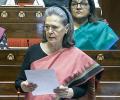
Congress Parliamentary Party chairperson Sonia Gandhi has criticized the Waqf (Amendment) Bill, calling it a 'brazen assault' on the Constitution and part of the BJP's strategy to keep society in a 'permanent state of polarization.' She also spoke out against the One Nation, One Election Bill, calling it a 'subversion of the Constitution.' Gandhi further accused the Modi government of ignoring the women's reservation bill and other demands for reservation, and of 'dragging the country into an abyss' where the Constitution will only exist on paper. She also criticized the government for limiting the speaking time of the Leader of the Opposition in Parliament and for not allowing discussions on important issues like the working of the defense and external affairs ministries and the challenges posed by China on the border.

The Supreme Court of India has appealed to women, particularly Hindu women without sons, daughters, or husbands, to make wills to avoid potential property disputes, highlighting the increasing number of women with self-acquired property.
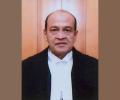
Officials aware of the procedure to appoint and remove Supreme Court and high court judges pointed out that while defending his case before lawmakers in any of the House, Justice Varma can announce that he is quitting and his verbal statement will be considered as his resignation.

Supreme Court judge Justice Ujjal Bhuyan emphasized the importance of delivering judgments without external influence to maintain public trust in the judiciary.
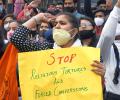
The Chhattisgarh high court has disposed of two petitions seeking the removal of hoardings prohibiting entry to pastors and 'converted Christians' in eight villages, holding that they were installed to prevent forced conversions through allurement or fraudulent means and cannot be termed as unconstitutional.

History would not see the institution kindly if it continues to avoid, as appears to be the case, hearing and deciding some of the most pressing issues of our time, asserts Aakar Patel.
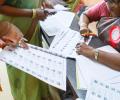
The Supreme Court declined to entertain a plea seeking a special investigation team (SIT) probe into alleged electoral roll manipulation in Bengaluru Central and other constituencies, advising the petitioner to approach the Election Commission of India.
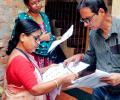
The Supreme Court expressed concern over threats to election officials in West Bengal and other states, urging the Election Commission to take action. The court also addressed the lack of cooperation from state governments in electoral roll revisions.
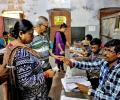
The Supreme Court has requested the Election Commission to respond to petitions challenging the Special Intensive Revision of electoral rolls in Tamil Nadu and West Bengal. The court has also asked the Madras and Calcutta High Courts to keep proceedings on similar petitions in abeyance.
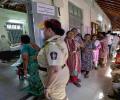
Maharashtra is set to hold local body elections on December 2 for municipal councils and nagar panchayats. The polls are seen as a test of the ruling coalition's strength after their recent assembly election victory.

'I don't know what people will say, but as a liberal Muslim, I can say that I had no problems with the viewpoint of the film. Because we are not maligning any community, if we were I wouldn't have done this film...'
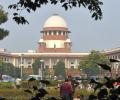
The Supreme Court is hearing arguments regarding a presidential reference on whether fixed timelines can be imposed on governors and the president for acting on bills passed by state legislatures. The court is considering objections to the maintainability of the reference under Article 143 of the Constitution.
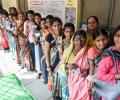
Maharashtra is set to hold local body elections for municipal councils and nagar panchayats, marking the first phase of a Supreme Court-mandated process. The elections are seen as a key indicator of political sentiment following the BJP-led Mahayuti's victory in the assembly elections.

The power of judicial review is being stretched to breaking point.
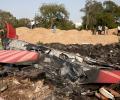
Father of deceased pilot and Federation of Indian Pilots petition Supreme Court for a court-monitored inquiry into the Air India flight AI171 crash in Ahmedabad.
The Supreme Court has sought responses from the Centre and others on a plea challenging the validity of a provision of the Income Tax Act that allows political parties to receive "anonymous" cash donations below Rs 2,000.
The Union Cabinet, at a meeting chaired by Prime Minister Narendra Modi, held a detailed discussion on the Supreme Court judgement on the sub-categorisation of reservation for SCs and STs as granted in the Constitution.
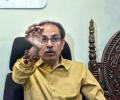
The Supreme Court has scheduled a hearing for January 21 on pleas challenging the Election Commission's decision to allot the 'bow and arrow' symbol to the Eknath Shinde faction of the Shiv Sena. The court will also hear arguments on a similar dispute concerning the Nationalist Congress Party (NCP) on January 22.

Describing the act as the 'grossest kind of indiscipline', the Supreme Court on Tuesday dismissed a former Christian officer's plea challenging his termination from the armed forces, after he allegedly refused to participate in regimental religious activities at the sanctum sanctorum of a temple at a place of his posting.

Lawful possession means having both actual control over a property and a valid legal right to keep it, usually based on a registered sale deed, lease agreement, or lawful allotment.

The Supreme Court on Friday adjourned to September 22 the hearing on bail pleas of activists Umar Khalid, Sharjeel Imam, Gulfisha Fatima and Meeran Haider in the Unlawful Activities (Prevention) Act (UAPA) case related to the alleged conspiracy behind the February 2020 riots in Delhi.
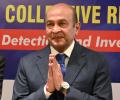
Lok Sabha Speaker Om Birla admitted a notice for the removal of High Court judge Justice Yashwant Varma and constituted a three-member committee to probe charges against him.

The Centre has argued before the Supreme Court that state governments cannot use writ jurisdiction to challenge the actions of the President and Governor regarding bills passed by state assemblies, particularly concerning fundamental rights violations. The President seeks the Supreme Court's opinion on whether states can file writ petitions under Article 32 and the scope of Article 361.
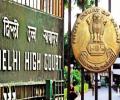
The Supreme Court collegium has initiated an initial inquiry against Delhi High Court judge Justice Yashwant Varma following the alleged discovery of a large stash of cash at his official residence during a fire incident. The collegium has also reportedly recommended Justice Varma's transfer to his parent high court, the Allahabad High Court. The inquiry will involve seeking a report from the Chief Justice of the Delhi High Court on the incident. The controversy surrounding the alleged discovery of cash was first reported by The Times of India. Justice Varma's proposed transfer is subject to the Centre's approval. The amount of cash found is not yet known. Justice Varma, currently heading a division bench dealing with sales tax, GST, company appeals and other appeals, did not hold court on Friday. Delhi High Court Chief Justice D K Upadhyaya expressed shock over the incident. The collegium reportedly received information about the cash discovery from government officials. Some collegium members have called for stricter action against Justice Varma, including seeking his resignation or launching an in-house inquiry. The Supreme Court has an in-house inquiry mechanism to deal with allegations against judges, which involves forming a committee to investigate and, based on the report, take further action. A judge of a constitutional court can only be removed through impeachment by Parliament.

The Supreme Court is examining the validity of the Election Commission's decision to conduct special intensive revisions of electoral rolls in several states, focusing on concerns about democratic participation and the burden on ordinary voters.

BJP-ruled states argued in the Supreme Court that governors and the President have autonomy in assenting to bills passed by state assemblies, asserting that courts cannot mandate assent.

The Centre on Wednesday told the Supreme Court that nobody can claim right over government land and it is legally empowered to reclaim properties which are declared waqf by using the waqf by user principle.

The Supreme Court has taken serious note of the digital arrest of a senior citizen couple in Haryana based on forged orders, highlighting the rising number of such cases and seeking responses from the Centre and CBI.

The All-India Football Federation has formed a three-member committee, headed by former judge Justice L Nageswara Rao, to oversee the entire tender process for selecting its new commercial partner, as per a directive from the Supreme Court.

The Supreme Court is scheduled to pronounce interim orders on key issues related to the Waqf (Amendment) Act, 2025, including the power to denotify waqf properties.

The Supreme Court questioned petitioners who challenged the accuracy of India's COVID-19 vaccine adverse effect data, suggesting they unduly trusted UK figures. The court heard arguments about alleged deaths due to the Covishield vaccine and reserved its order.
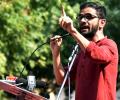
Activist Umar Khalid has appealed to the Supreme Court against the Delhi High Court's decision to deny him bail in a case under the Unlawful Activities (Prevention) Act (UAPA) related to the alleged conspiracy behind the February 2020 Delhi riots.

In more than one way, it's a setback for the DMK and Chief Minister Stalin in political terms. The electoral fall-out, if any, will have to wait until the next summer, only when assembly elections are due in the state, explains N Sathiya Moorthy.
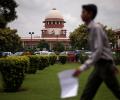
The Supreme Court is scheduled to pronounce interim orders on key issues related to the Waqf (Amendment) Act, 2025, including the power to denotify properties declared as waqf.

Sports Minister hears out I-League representatives; urges constructive dialogue
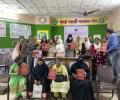
'Every issue that Muslims are facing today affects Muslim women. But how come women's issues don't affect the community?' 'How does the community benefit by the practice of halala or polygamy?'

Prime Minister Narendra Modi on Tuesday ceremonially hoisted a saffron flag atop the Ram temple in Ayodhya, marking the formal completion of its construction.
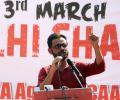
The Supreme Court on Monday sought the Delhi police's response on the bail pleas of activists Umar Khalid, Sharjeel Imam, Gulfisha Fatima and Meeran Haider in the UAPA case related to the alleged conspiracy behind the February 2020 riots in Delhi.
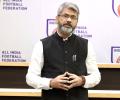
Majority of AIFF EC members to choose between national body posts and state unit office
